
 Deutsch
 Español
 Türkçe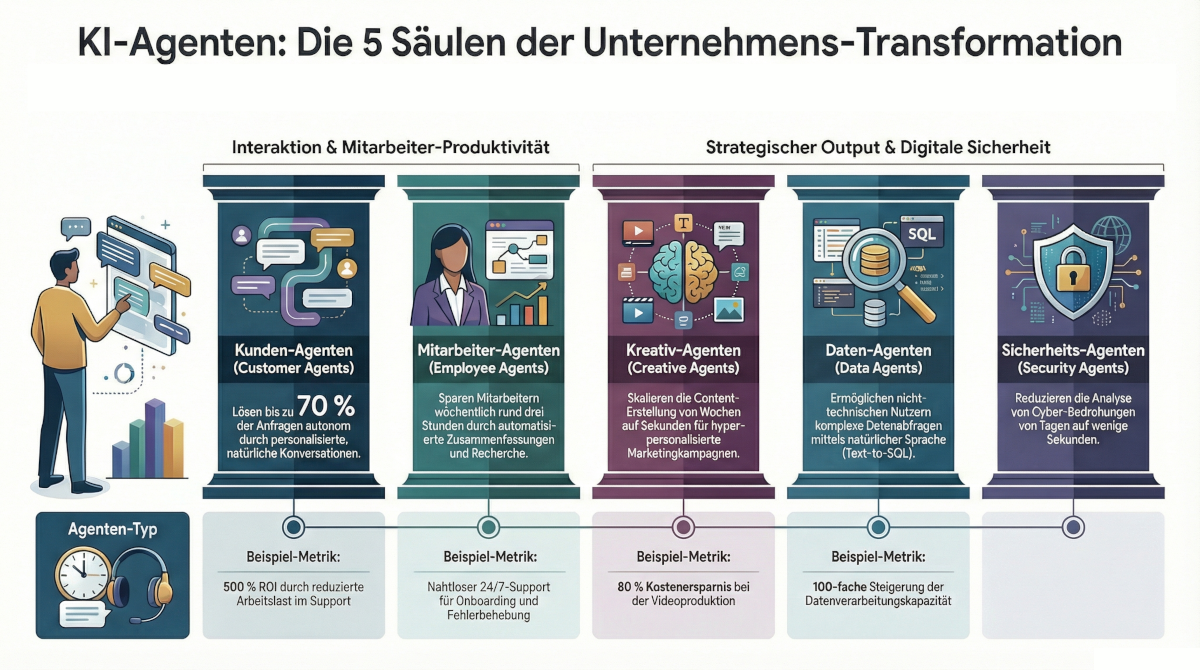
Generative Artificial Intelligence (Gen AI) has rapidly evolved from an experimental technology to a fundamental driver of business innovation. Initially seen as a tool for drafting texts or creating simple images, recent industry data paints a different picture: companies worldwide are productively using AI to solve complex problems, enhance efficiency, and create entirely new customer experiences.
This article summarizes key insights from over 100 real-world use cases and highlights how leading organizations—from global banks to retailers and healthcare providers—are utilizing this technology today.
The Five Categories of AI Agents
To comprehend the range of applications, it is useful to categorize them into six types of "agents." These agents are not futuristic robots but specialized AI systems revolutionizing specific task areas.
1. Customer Agents
These systems transform customer service from simple FAQ bots to intelligent assistants.
- Examples: Automotive manufacturers integrate AI into vehicles so drivers can communicate with their cars in natural language. Retailers use AI sommeliers that recommend the perfect wine to customers based on their preferences. Banks deploy chatbots that not only answer questions but also autonomously execute complex transactions like transfers.
- Value: They offer 24/7 support, drastically reduce wait times, and enhance customer satisfaction through personalization.
2. Employee Agents
The focus here is on increasing workforce productivity. AI acts as an intelligent assistant to take on repetitive tasks.
- Examples: In HR departments, bots answer queries about vacation policies. In administration, systems summarize lengthy documents or email threads and draft responses. For maintenance technicians, AI tools search technical manuals and provide instant repair instructions.
- Value: Employees are freed from administrative burdens and can focus on strategic or creative tasks.
3. Creative Agents
Marketing and design teams use generative AI to produce and personalize content on a large scale.
- Examples: Global brands create thousands of ad variations to target different audiences without conducting separate photo shoots for each version. Video platforms automatically generate subtitles in dozens of languages or create highlight clips from extended video material.
- Value: Faster time-to-market for campaigns and enabling hyper-personalization that would not be scalable manually.
4. Data Agents
These agents democratize access to data analysis. Instead of writing complex SQL queries, employees can ask questions in natural language.
- Examples: Logistics companies use AI to predict supply chain risks by analyzing news and weather data. Financial analysts get summaries of business reports and extract trends. In healthcare, these agents help researchers sift through vast amounts of clinical data to recognize patterns for disease outbreaks.
- Value: Faster decision-making and use of corporate data by non-technical staff.
5. Security Agents
In an era of increasing cyber threats, these agents bolster companies' defenses.
- Examples: AI models analyze security incidents in real-time, summarize threat levels, and suggest countermeasures. They can help detect fraud attempts in financial transactions in milliseconds.
- Value: Faster response to attacks and relieving security teams by automating routine monitoring.
Industry-Specific Highlights
Analyzing the use cases shows that no industry is untouched:
- Retail: From virtual try-ons to smart inventory management that recognizes shelf gaps before they occur. Personalized search is a key factor here—customers can input phrases like "I need an outfit for a beach wedding" and receive curated results instead of simple keyword matches.
- Healthcare: AI drastically accelerates drug development by predicting protein structures. In hospitals, it automates the creation of discharge reports and assists radiologists in identifying anomalies in X-rays more quickly.
- Financial Services: Besides fraud detection, banks use AI to review complex regulatory documents or make personalized investment advice accessible to a broader client base.
- Manufacturing: "Digital twins" of factories allow for virtual optimization of production processes. AI vision systems monitor quality control on assembly lines and automatically sort out defective parts.
From Prototype to Production: Success Factors
Despite the hype, many companies face the challenge of transitioning AI projects from the experimental stage to everyday productive use. Successful implementations are characterized by three features:
- Choosing the Right Platform: It's not just about the AI model itself, but the infrastructure surrounding it. Companies need platforms that offer security, scalability, and the ability to "ground" models with their own corporate data to minimize hallucinations.
- Measurability: You cannot improve what you do not measure. Successful projects define clear KPIs (Key Performance Indicators) for their AI models, such as response accuracy, latency, or cost-efficiency per transaction.
- Responsible AI: Security and ethics are not side issues. Protection against "Prompt Injection" (manipulation of AI through inputs) and ensuring that sensitive data does not leave the company are essential for productive use.
Generative AI is much more than a chatbot. It is a foundational technology that enables companies to utilize their internal knowledge more efficiently, automate processes that previously required human cognitive effort, and advance innovations more swiftly. The key to success no longer lies in mere access to technology but in its strategic integration into existing business processes and data landscapes.